
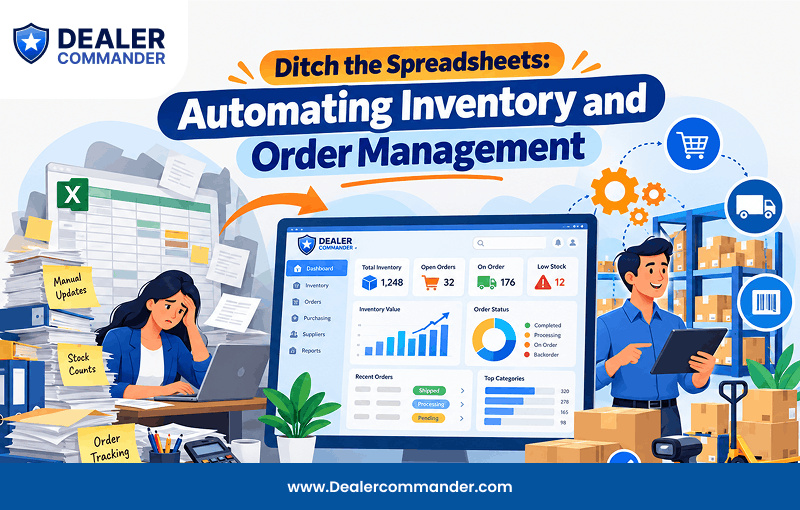
Spreadsheets work to a level of satisfaction- but only for micro businesses. Anything bigger in size or complexity, or even a sudden increase in order volumes, means the whole edifice of manual inventory management is likely to fall apart like the proverbial pack of cards, resulting in errors, stock outs, delayed deliveries or worse, a complete wipe-out of working capital, all of which would not only hurt profitability but, worse, kill customer trust.
The solution, and the only one, is to automate inventory management with an integrated approach that, among other things, improves accuracy, simplifies workflows, and supports sustained business growth.
1. The Breaking Point of Spreadsheet Management
Spreadsheets have their usefulness BUT only till a certain level. Beyond the basics, they become nothing short of a nightmare. Consider a scenario with 1,000+ SKUs (and multiplying), plus the same number of warehouses and orders across the world. Even the smallest oversight (not even an error)- like an employee who forgets to update stock entries and movements, or double-entry of the same, etc. is a scenario that ruins the usefulness of spreadsheets.
Common challenges with spreadsheets include:
- Inaccurate records: Manual updating is prone to creating differences between recorded and actual stock.
- Opaque visibility: Sales teams may have to wade through information present across multiple files and locations.
- Slow reporting: The above scenario is evidence enough of how employees may spend hours combining data instead of analyzing performance and serving new clients and orders.
- Frequent stock outs/ overstocking: Delayed or cautious updates bring about these scenarios, both being unhealthy.
With business expanding, such problems become harder to put down. What is then required to maintain reliability is to automate inventory management, which reduces multiple manual data entries, leading to higher visibility and accuracy in stock counts.
2. How Manual Order Entry Kills Profitability
Every order goes through several steps before its completion. From customer details to stock-checking (at every point, pick-pack to forwarding), to documentation (invoices, certificates and the like), to movement and final delivery. Imagine the scenario where each of these, or even a sizable number, is recorded on separate spreadsheets and systems. Not only will there be repeated entering of the same order, but an increasing likelihood of wrong or double entries. This would waste time and effort and, worse, create an unclear picture of everything.
Some ways in which manual order processing affects profitability:
· Data Duplication: Moving same order-related details between spreadsheets, inventory records and accounts can cause mistakes, oversight or double entries.
· Errors taking place while entering data: It is human to make mistakes and entering incorrect details like product codes, quantities or prices, may lead to wrong dispatches, returns and avoidable extra costs.
· Delayed order fulfillment: Manual stock-taking and checking is known to be slow, tedious and cumbersome leading to slow dispatch and final order fulfillment.
· Bad customer experience: Late or incorrect deliveries damage trust. Customers may also leave a supplier.
· Higher operating costs: Correcting mistakes costs valuable resources and may sometimes not suffice. Poor inventory management can lead to costly supply chain mistakes, increasing operational expenses and reducing efficiency.
Replace spreadsheets for order management, and you effectively do away with repetitions that goes a long way in improving consistency, efficiency and the efficacy of deliveries and customer retention.
ERP order processing brings everything together on a single plane, from accepting customer orders to evaluating inventory, invoicing, and order fulfillment- all without multiple entries. It leads to improved visibility, speed, and real-time information flow, all of which lead to happier customers.
3. Introducing Automated Inventory Control
Inventory control software centralizes data entry, thus helping businesses manage stock & give visibility across activities- with a single click. Decisions become faster, informed and decisive. In all this, Dealer Commander brings about an integrated ERP ecosystem for dealers to manage inventory and order-related activities till final delivery.
Key benefits are:
- Real-time stock visibility: Employees get to see real-time, on-the-go stock status across locations before order confirmation.
- Automatic stock updating: ERP Order processing updates inventory status by means of connected workflows. One entry doesn’t need to be repeated across locations and situations.
- Better warehouse usage: Improved stock visibility across storage locations means better order fulfillment with just the right resource, including reduced warehousing space.
- Improved order accuracy: Real time inventory status using inventory control software reduces the risk of over promising.
- Accurate & Fast reporting: Not everything flows as fast. Real-time info on stocks informs which items need to be overstocked and which can be dispensed with, thus rationalizing working capital.
Inventory control software does way more than what a set of disparate spreadsheets can do. It connects independent processes so that information flows with speed and accuracy. This helps marketers take faster action for higher customer happiness.
4. Streamlining the Purchasing Process
Stocking, be it over or under, can undo the best organization. Knowing stock levels alone isn’t enough for inventory management. It requires precise timing for reordering, what to order, how much, and from where. At the center of this is reliable data, which you get only when you automate inventory management!
Advantages of Inventory Automation:
- Automating reordering: By automating stock reordering to preset minimum levels backed by alarms, marketers never have to bother about overstocking or stock-outs.
- Better demand planning: Data on customer’s buying habits helps distributors to forecast and take actions for higher customer satisfaction and profits.
- Tighter working capital needs: Replenishing just what is needed and when means less working capital gets stuck in the system, leading to profits despite tight competition.
- Purchase order tracking: Monitor outstanding orders and identify delayed deliveries.
- Optimum stock levels: Better demand and stock visibility means sellers needn’t purchase and store unnecessarily and incur extra storage expenses.
The above points hold particularly well in the case of sellers with large product catalogs, SKUs and varied demand patterns. When businesses replace spreadsheets for order management, teams get to spend time planning and creating strategies rather than fire-fighting.
Another aspect of stocking is the lead time. ERP order processing helps sellers account for lead times, seasonal demand and minimum order quantities. All these help avoid stock-outs.
5. Real Results for Growing Dealers
Consider a wholesale dealer with over a thousand SKUs. With the business processing hundreds of orders weekly, using separate spreadsheets for inventory, purchasing, and order tracking becomes a nightmare as sales increase. Discrepancies would be commonplace with employees spending precious time checking and re-checking actual order levels before committing anything. What the dealer needs to make the most of the state is an ERP order processing system
Potential plus-points would include:
- Reduced manual entry. Automation reduces multiple entries of the same records. Less effort and time.
- Fewer errors: With reduced multiple entries of the same details, chances of duplication and/ or mistakes are reduced drastically.
- Better stocking: With automated reordering, there is reduced fear of order disruption.
- Faster order processing: ERP order processing leads to faster processing, inventory control and higher customer satisfaction.
- Smarter decision-making: Consolidated real-time reports from inventory control software show purchasing patterns, speed of product movements and existing bottlenecks- all of which can then be addressed effectively.
When you automate inventory management, the real benefit is scalability: increase order volumes without a proportionate increase in effort.
6. Take the Next Step Towards Automation
Spreadsheets have done their best. What you may need now, given growing order volumes and logistics operations, is ERP order processing, which Dealer Commander can provide by improving stock visibility, streamlining purchasing, and reducing repetitive tasks.
If you seem to be spending far too much time on stock checking, error updating and fire-fighting, it’s time you looked into inventory control software.
Ready to move beyond spreadsheets?
Request a Dealer Commander demo focused on inventory and warehouse control. It’ll show you how connected workflows improve order accuracy, replenishment and prepare a business for the next level of growth.